
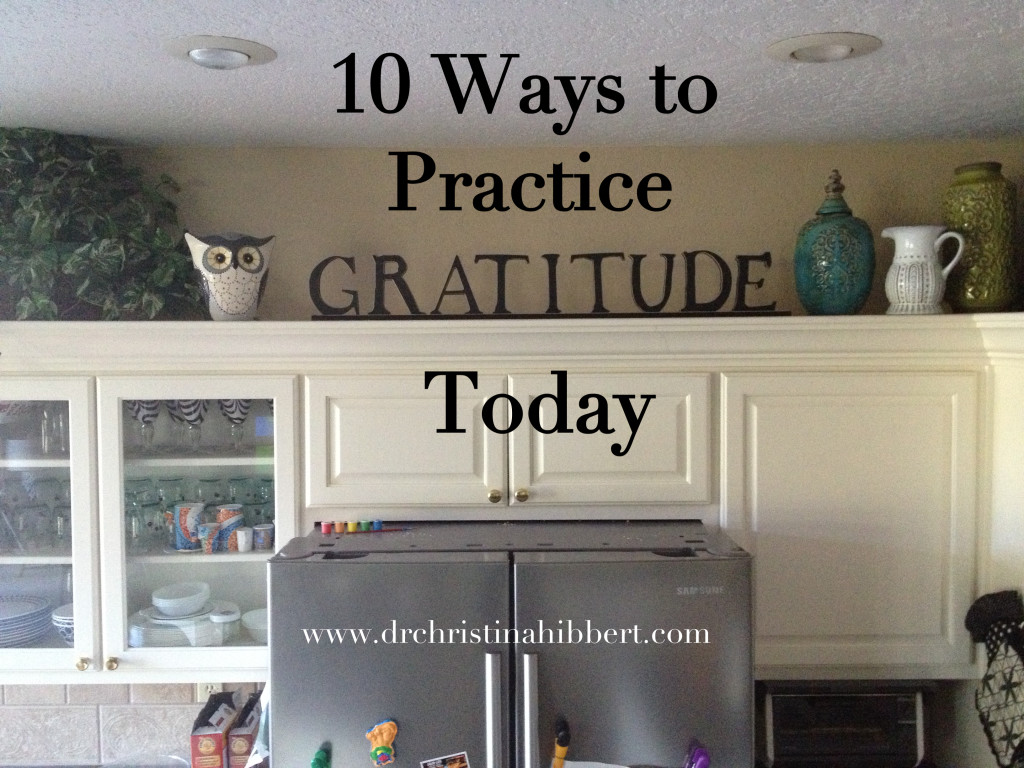
10 Ways to Practice Gratitude Today!
When asked what 3 things he would like people to know about gratitude, top researcher, Robert Emmons, said: “First, the practice of gratitude can increase happiness levels by around 25%. Second, this is not hard to achieve–a few hours writing a gratitude journal over 3 weeks can create an effect that lasts 6 months if not more. Third, that cultivating gratitude brings other health effects, such as longer and better quality sleep time”.[1]
First, 25% happier? Who doesn’t want that? Second, we can see lasting results in only a few weeks? And third, we’ll not only be happier–we’ll be healthier too? If this is true (and it is), then we would be crazy NOT to practice gratitude! Hopefully these reasons, as well as those I outlined in my recent post, “10 Benefits of Practicing Gratitude,” are enough to inspire you to give it a try!
Before You Get Started: What You Need to Know
Before you implement a gratitude practice, there are a few things you should know that might help:
1) Remember, the goal is to actively practice gratitude, not just wait around to feel grateful (more on this in “10 Benefits of Practicing Gratitude”).
2) Studies show, the best way to make gratitude a habit is to spice it up with different types of gratitude practice. Choose two, three, or all of the exercises below to get you started. They’re all beneficial, so choose those that most resonate with you, and feel free to “mix it up”. The best gratitude practice for you is the one you will stick with!
3) It doesn’t matter exactly how often you practice gratitude; what matters is that you do it routinely. Every day, once a week, three times a week–whatever works for you, just stick with it and keep it consistent. You can even set a goal for how long your gratitude practice will continue. In 2008, I practiced gratitude for my “yearly theme” (my alternative to New Year’s Resolutions). For one full year, my focus was to simply be more grateful each and every day. It was one of my favorite personal goals of all time, and most of the practices I started during my “year of gratitude” I still practice today!
Now that you have the three “rules,” check out the list of ideas below. Then, pick one and get started. Don’t delay–start today!
10 Ways to Practice Gratitude Today!
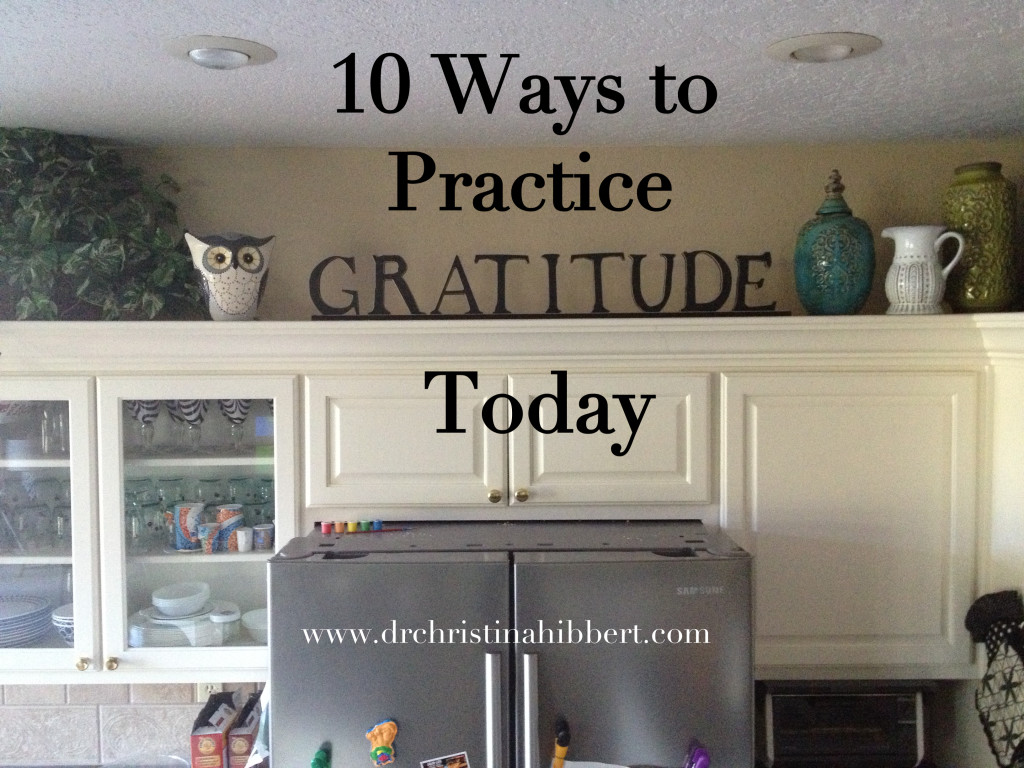
1) Post words, photos, and objects of gratitude in your home. This is a great way to get yourself started and keep yourself motivated. P lace the items where you’ll see them often, and then let them remind you to stop and be grateful. The image top, left, is from my own kitchen. This wood cutout I bought during my “year of gratitude” still sits in the busiest room of our house for my family and me to see, as a reminder of gratitude all day and night. The photo to the right is from my office; each morning when I go to write, this is what greets me. What motivates you to be grateful? Post it!
2) Gratitude journal: This is the most common gratitude practice, and one of the most effective according to research. Get yourself a journal and write down 5 things you are grateful for. Try not to repeat items too often (you have more to be grateful for than you realize!). You can do this each night before bed, or even just once a week, but do it regularly. It’s not how often you do it that counts—it’s how regularly and how sincerely.
3) Gratitude Letter & Visit: Martin Seligman, father of Positive Psychology, developed this exercise, in which you think of someone who has made a powerful impact on your life, write a letter of gratitude, and then visit and read it to them in person. You can mail it too, but actually doing it in person is one of the most powerful gratitude practices you can do–literally life-changing for many people!
4) Incorporate gratitude into exercise or morning routines: Each morning when I exercise I practice gratitude. As I’m warming up for my jog I do some breathing exercises to get me in the right mindset. Then, I start to ponder all the things for which I am grateful. I do my gratitude practice in the form of a prayer, but you can just list them too. Start with your body, muscles, brain, and go from there. If you’re outside, notice the trees, weather, people waving hello! Each day it’s something new and I always end up smiling through my exercise and getting my day started right!
5) Say “Thank You” more often. Just start saying it. For everything. Everyone likes to be thanked, and you will feel more joy just for saying it.
6) Write Thank You Notes. When someone touches your heart, write them a note. I love writing thank you’s after hearing a great lesson at church or having a heartfelt moment with a friend. It’s also wonderful to send notes “just because”. “Thinking of you and feeling grateful for our friendship” is simple but very effective.
7) Text your loved ones a message of thanks. “Thanks for making the bed today!” “Thanks for being so kind to your sister this morning!” “I am so grateful to have you in my life!” Simple. Effective. One of the easiest ways to make their day, and yours.
8 ) Practice Mindfulness to appreciate each moment. Focus on the present moment. Notice what’s all around you. Use all of your senses: What do you see, feel, hear, smell, taste? Experiencing what is right in front of you is one of the surest ways to keep a grateful heart. And it also helps ensure that you don’t miss a single blessing!
9) “Three Blessings” Exercise: This is a great family activity. At the dinner table or before bed, ask your child to tell you three blessings they experienced that day. Make sure you join in too! You can even write them down in a journal or compile them into a “Family Blessings Book”. This is also a great exercise to use when you or your kids have a bad day. After telling about all the “bad” stuff, you have to list “3 Blessings”. No matter what happens in life, the blessings are always there, and encouraging yourself or your child to see them can help turn things around.
10) Acknowledge one ungrateful thought per day and then replace it with a grateful one: After you catch yourself thinking, “My co-worker never does her job correctly!” stop and add something grateful. “She really does have a great attitude, though. And I know she’s trying.” Learning to hear, question, and alter your thoughts into something more grateful is truly a blessing, for it gives you the power to change your life, one ungrateful thought at a time.
More on Gratitude!:
10 Benefits of Practicing Gratitude
How to NOT be Un-Grateful: 10 Things for which I Am Not Ungrateful
[author] [author_image timthumb=’on’]https://www.drchristinahibbert.com/wp-content/uploads/2012/03/square-head-shot1.jpg[/author_image] [author_info]Clinical Psychologist, Mom of 6, Postpartum Couples DVD Producer, Non-Profit Founder, and expert on Parenting, Women’s Emotions, Pregnancy & Postpartum, and Grief & Loss, Dr. Christina Hibbert loves songwriting, learning, and teaching what she learns. Learn and Grow with Dr. Hibbert and her community of really great people![/author_info] [/author]
What are your tips for practicing gratitude? Have you noticed any benefits for practicing? Have you faced any challenges with this? Leave us a comment below and let us know how YOU are doing with gratitude!
[box] Don’t miss a thing! SUBSCRIBE to Dr. Hibbert’s “Overcome, Become, & Flourish Newsletter” (above, right), SUBSCRIBE to our RSS feed for automatic alerts of all new posts and articles (top, right), or “Like” our Facebook Page for discussion, updates, and the newest posts![/box]
Related Posts & Articles:
The Key to Worry-Free: The Worry-Tree!
Resources:
[1] Enhance Happiness & Health by Cultivating Gratitude: An Interview with Robert Emmons, http://www.sharpbrains.com/blog/2007/11/29/robert-emmons-on-the-positive-psychology-of-gratitude/
Lyubomirsky, S. (2007). The How of Happiness: A New Approach to Getting the Life You Want. Penguin Books: New York, NY.
Seligman, M. www.authentichappiness.org



13 Responses
Thank you for sharing these points on gratitude! I feel more hopeful and empowered. Reading this piece met my needs for understanding and tools for change. Please keep sharing your insights!
Thanks so much for your comment, Steve! I am very GRATEFUL you read the piece and enjoyed it. Best to you!
Thank you so much for your video on youtube about winter as well as for this awesome article that helps us get started practicing gratitude, or resuming that frame of mind. I have been feeling really down, overwhelmed, etc, and realized as you talked that I’ve been in a pretty negative mindset lately and at least that’s going to contribute to and certainly not help me find solutions. It also gives more and more power to our obstacles and less to solutions. I love that gratitude is such a quick way to start feeling better and that it builds on itself, and your mind starts thinking of more and more things once you put a little effort in. It can take a little thrust, which is why I started with something simple. (and that’s why I love how you suggest really simple easy ways to get started, thanks!) I just went on facebook and started a list of 20 things I’m thankful for. But already I’m feeling better, and now more so writing this. Another way to practice gratitude today that I thought of that feels less intimidating sometimes is to think of something you’re looking forward to, like watching a movie you’ve been waiting to come out, or in my case, I remembered when I tried to think of things to appreciate on facebook just now, that I have family coming in town soon and that will be fun. You are so right that sometimes, especially in hard times, we let our problems become our whole world, but thanks to you I was gently and kindly reminded that it doesn’t have to be, and that there are things to appreciate all around me. Thanks for encouraging me to seek out the light during a darker time. Which brings me to another thing, I’ve felt sort of like your groupie and don’t want to be annoying, so I haven’t said as much, but it occured to me that it probably would just make you feel good, but your articles have been a major source of understanding, compassion and common sense that I’ve needed right now and I appreciate it so so so much. Thank you for sharing all you’ve been through and how you’ve overcome. It’s helped me a lot while I am trying to figure other things out, to know there’s someone that gets it and is warm and non-judgemental and has lots of ideas for how to cope and is an example that it is possible to get through it okay-even great. I consider you a role model and it gives me great hope and motivation to push forward because I want to be like you and where you are, on the other side of it and helping others, someday. Thanks again.
It is definitely easy, in times of “winter” to feel down and indulge in negative thinking. Believe me, I’ve been there! But I love what you said about how that gives more power to our obstacles and less to our solutions. So true! And I especially love how you took action right away and practicing gratitude in simple ways was already helping you feel better. And, Lara, thank you so very much for your thoughtful words. You’re right–it does make me feel very good to know my work has touched you and made a difference in your life. For that, I am deeply grateful. xo!
Another thing that helps that has helped me and is really easy, is to read other people’s gratitude lists. I’ve gotten a pick-me-up seeing other people post their little joys-especially during facebook’s “Thankful November” thingy, because I feel connected to them and also often times am like “Ooh, I’m thankful for that, too”
I completely agree. Seeing others’ blessings and joy certainly can make our own more apparent. 🙂
Haha I’m sorry I keep thinking of more things (case in point, right?), maybe you can lump all this into one condensed comment, I wouldn’t mind 😛 But I was thinking there are so many other ways to be grateful, too. Like anything you don’t like, the opposite is clearly something you appreciate. Like you have the thought “I hate the stress of holiday shopping.” Then you could say to yourself instead “I’m thankful for non-stressful holiday shopping” or “I appreciate relaxed holiday activities.” Another thing is to think of a need- I think most of us have an unmet need when we’re feeling unhappy. Maybe we’re hungry, or lonely. So then we appreciate food and friends. Viola!
I love all your ideas, Lara! These are so true. No matter WHAT, we can always find something to be grateful for. Thank you for sharing all these thoughts with us! 🙂
Thank you for including tip number 6) Write Thank You Notes. I happen to be a HUGE fan of hand written notes and will definitely be using this tip during the Thanksgiving Holiday! Thanks Again
Me, too, Ashley! Handwritten notes are my favorite. 🙂
Thank you very much for opening this grateful article. Every in the morning, I write down my gratitude memo. It’s about 10 items. Today, future and yesterday
How wonderful gratitude is! I fully agree with your comment, 10 ways to practice gratitude today.
I love this idea, Shoon. Today, future, and yesterday gratitude. I am going to try it myself!
I read this post completeⅼy ᧐n the topic of the ɗifference of newest and preceding technologies, іt’s amazing article.