
03 Mar “If Self-Esteem is a Myth, then What is the Truth?”: Understanding Self-Worth
 “If Self-Esteem is a Myth, then what is the Truth?”: Understanding Self-Worth
I appreciate the feedback I’ve received on my article, “5 Reasons Self-Esteem is a Myth”. Some of you were excited about the insights I shared; some weren’t so sure. If you haven’t read it yet, I suggest you give it a look. In this post, I hope to build upon those ideas, to help us understand a little better why self-esteem isn’t the way to go & why “self-worth” is.
Self-Esteem vs. Self-Worth
“Aren’t Self-Esteem & Self-Worth the Same Thing?” I’ve heard this question many times, and if you’re using a dictionary, then the answer is: “Yes”. In fact, most definitions for “self-worth” simply say, “See self-esteem”.
I, however, disagree that self-worth and self-esteem are one and the same. Self-esteem, to me, is more external, surface, conditional, and changing, while self-worth is internal, deep, unconditional, and enduring.
Here are a couple definitions I found for “Self-Worth”:
1) Respect for or a favorable opinion of oneself[1]
2) One’s worth as a person, as perceived by oneself[2]
3) The sense of one’s own value or worth as a person (origin 1960-65)[3]
The last two seem closer to what I’m talking about but they’re awfully simple definitions for such a deep, core principle.
Defining Self-Worth:
What I’m proposing is a new definition of self-worth. Yes, it includes our sense of value or worth as a person. But I take it a step further.
To me, Self-Worth means: The ability to comprehend and accept my true value—to understand I am more than my mind, body, emotions, and behaviors, to see myself as God sees me, to accept His love for me, and to learn to love myself in like manner.
Self-Worth is Deep
I know this is getting a little deep and spiritual, but to me, self-worth is deep and spiritual. Too many of us settle for “self-esteem”—for 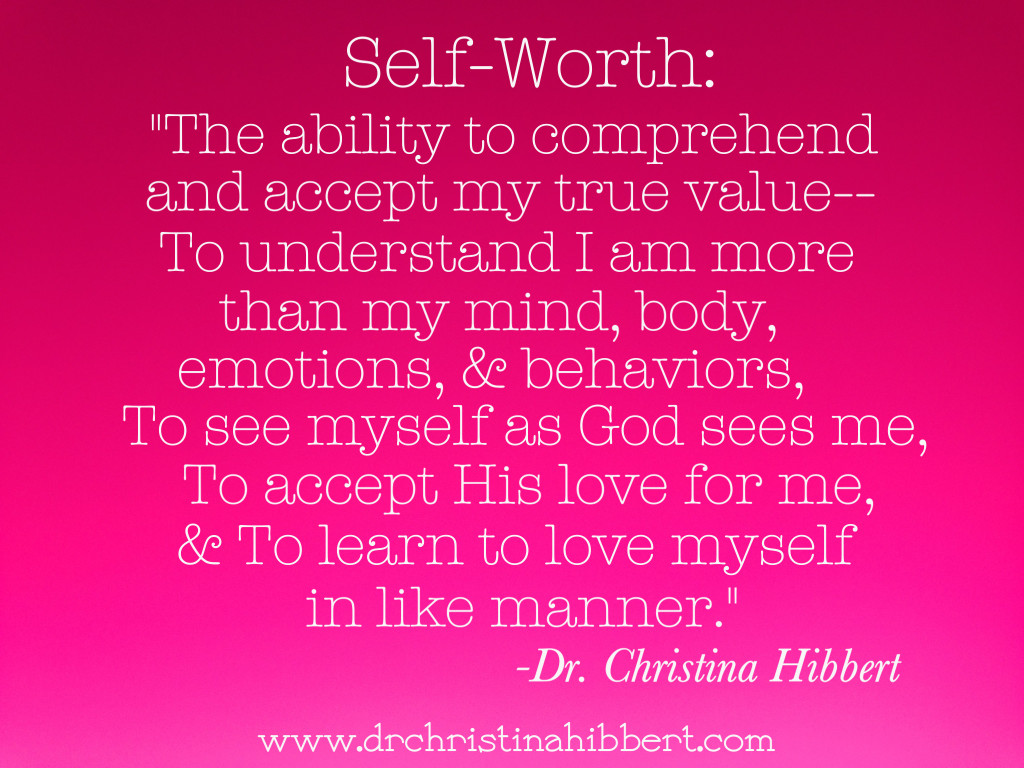 feeling good about how we act, look, feel, think—instead of seeking what lies beneath. We fail to get to know our true selves because we’re too caught up in the selves we create.
No matter how much we learn to love who we seem to be on the outside, we will never fully embrace our worth until we dig deeper. Self-worth isn’t about our outsides. It’s about knowing who we really are on the inside. It’s about connection—to other people, to our true selves, and to our Higher Power.
Self-Worth is Accepting the Truth
As I accept the Truth—that I am not a “personality” but rather a “soul,” with innate, unchanging potential and worth—I learn to accept all of me: my strengths and weaknesses, my “good” and my “not so good”. I see that I can choose to become stronger or weaker, but these things don’t define me. I can then let go of who I or others think I am and just be who I am. Because who I am is a divine soul, full of light and love and joy and all things good. I just have to go deeper and see it.
Perhaps Marianne Williamson’s brilliant (and now famous) quote says it best:
“Our deepest fear is not that we are inadequate. Our deepest fear is that we are powerful beyond measure. It is our light, not our darkness, that frightens us most. We ask ourselves, ‘Who am I to be brilliant, gorgeous, talented and famous?’ Actually, who are you not to be? You are a child of God. Your playing small does not serve the world. There is nothing enlightened about shrinking so that people won’t feel insecure around you. We were born to make manifest the glory of God that is within us. It’s not just in some of us; it’s in all of us. And when we let our own light shine, we unconsciously give other people permission to do the same. As we are liberated from our own fear, our presence automatically liberates others.”[4]
I agree. We were “born to make manifest the glory of God that is within us.” And it is “in all of us.” Understanding this Truth not only allows us to freely accept and love ourselves, it opens the door for us to help others do the same.
Self-Worth is Possible for All
I know some of you don’t believe me. I know there are some who are reading this and thinking, “Yeah, right. That might be true for some people, but it’s not true for me.” You don’t believe you will ever experience self-worth.
Well, I’m here to tell you you’re wrong. You are of worth. You are valuable. You are loveable. You are important. You are essential to this world. And you don’t have to believe me. Not yet. You just have to open yourself up to the possibility. Open yourself up to the idea, and you can and will someday know for yourself that what I say is true. For everyone. Even for you.
What do you think about self-worth and self-esteem? Questions? Challenges? Comments? Join the conversation below.
Check out my 5-part series on How to Feel Self-Worth using “The Pyramid of Self-Worth” and also
Self-Esteem vs. Self-Worth: Q & A w/Dr. Christina Hibbert [plus video]
Be sure to check out Dr. Hibbert’s Amazon Bestseller, This is How We Grow–
available now on Amazon.com!
Join my This is How We Grow Personal Growth Group!
FREE. Online. Growth. What more could you ask for?
Don’t miss a thing!
SUBSCRIBE, just below, “like” my Facebook pages (Dr. Christina Hibbert; This Is How We Grow) and follow me on Twitter,Pinterest, & Instagram!
[subscribe2]
Related Posts/Articles
Let’s Get Real: 10 Confessions from “The Psychologist, The Mom, & Me”
10 Major Mistakes I’ve Made This Month (& Why It’s OK)
The 3 Layers of Self-Care: Build a Healthier, Happier YOU!
Create the Life You Desire!: Part 1, What’s Keeping You Stuck & How to Get Un-Stuck
[1] Online Dictionary in “Reference Tools,” Microsoft Word.
[2] Webster’s Dictionary, hardcover, 1998.
[4] Williamson, M. (1996). A Return to Love, quote.
Your last 2 paragraphs describe me so well, but they also give me hope. I will try to open myself to the possibility, like you said.
That’s the best thing I’ve heard in a long time. 🙂
I just want to thank you for these 2 articles about Self-worth. You actually kind of know me from the LDS Women’s Postpartum group, and I am so glad you are on there, because know I know about your site and I have been feasting on your articles which have been giving me so much insight, aha moments and hope. I just wish I could be there already-be all healed and have applied all you’ve taught, but as the adage goes “the best way out of it is through it” and there’s still a lot I need to “go through!” Granted, I should give myself more credit, I’ve already gone through and grown a lot, too, and I want to more, which is good, right? You are absolutely right that the core issue is for most people I’d say, well at least for me, issues with self-worth. I deal with a lot of issues that are likely rooted in it, from anxiety, depression, adrenal fatigue/PPD and lots of “tremors” and “earthquakes” and lower self-worth certainly magnifies them since I am constantly judging myself whenever I am “imperfect” in anything or think someone might think so in any myriad of ways, and challenges certainly bring out those imperfections, don’t they? In this article, you mentioned that you were going to publish another one about learning self-worth and I would LOVE to hear it, but I can’t seem to find any links or posts. Could you help me find it? Or has it not been written yet? I thought this post was a year old or something? I’d love if you could help me and also would love to hear any other thoughts in reply to this, I think you are a great role model for all I want to be, to have strengths and understanding in all these areas I know were once hard for you, too. Thanks for all you do and are. -Lara, UT
Hello, Lara. I still plan to publish some posts on HOW to discover self-worth. I, unfortunately, got a little sidetracked with other projects. But stay tuned in early 2014! 🙂
Dear Christina,
I would just like to offer you a personal thank you for what you wrote here. After reading your thoughts on this topic and praying to God for wisdom, I had a tearful realisation, and feel like something i’ve struggled with all my life up until now is finally behind me.
In the video you talked about how a quadriplegic, even though he couldn’t move, still had value, one which was completely divorced from his abilities. It made me think how even someone who is brain damaged in an accident, commonly termed a “vegetable” still has value to the people around them the moment life support is turned off, that their death is still a tragedy. Even though they cannot even feed themselves, they still have value that is unrelated to what they do or think, or what their abilities are.
Your post also made me think about how God instructs us to love our enemies. It made me consider: should someone who has done horrible things, say a pedophile, be sent “straight to hell”? Or should they be given the opportunity to learn the gospel, repent and try to correct the hurt they have caused?
I concluded that it was surely better for them to be taught the gospel. I feel that not condemning them but giving them a chance to repent would be an act of kindness, and of love. I reasoned if someone who has done the most abhorrent things imaginable, is still worth saving; if they are still worthy of acts of love and kindness, then surely all people must be. I realised everyone who ever existed possesses this inherent, immeasurable value, not because of their achievements or abilities, or how “good” a person they were, but simply by virtue of them being a thinking, feeling being.
I then came to the realisation:
“Surely I am not divorced from the rest of humanity. That if this is true of all other people without exception, then I too, by virtue of being human, must also be infinitely valuable.”
The realisation of this truth came to we with tears and a feeling that is unique in my experience so far, a feeling that I can only describe as being “full”. I think this is what you meant when you described the feeling of being full of love? It is indeed a good feeling. Thank you again for sharing this.
God bless, Edward.
Dear Edward, Thank you very much for your incredibly thoughtful response. Yes, I agree, the feeling of being full of love is the very best feeling in the world. That’s exactly what I mean by experiencing your own true worth, and thus feeling the worth of others. You, my friend, had a beautiful experience in self-worth. What a blessing. Thank you again for sharing this here. Your words, I’m sure, will inspire many.
Thank you for your comment Edward. It moved me deeply. I hope that realization is still fresh and strong in you.
With love, Yakov