“The 5 Love Languages”: Improve Relationships & Feel the Love
“She doesn’t understand my needs at all!”
“If he really loved me, he would show it!”
“We’re living like roommates now–the spark is completely gone.”
As a Clinical Psychologist, I hear these complaints all the time. Couples who don’t understand each other, couples who don’t feel loved, couples who fear they’re beyond repair. And I get it–maintaining strong relationships is one of the toughest parts of life.
But, to the couples who have small struggles, to those with seemingly huge struggles, and to all in between, I say this: You’re never past repair until you quit. As long as you’re both willing to work on your relationship, there’s always hope. And the one tool I believe offers the most hope is “The 5 Love Languages”.1
The Problem with Intimate Relationships
I recently posted the following question on my Facebook page: “In your opinion, what is one of the biggest roadblocks to relationship success?” Some of the responses I received included: ”Failure to communicate,” “Being too busy to take time for each other,” “Lack of appreciation,” “When your spouse just doesn’t care,” “Expecting the other person to make you happy,” “Lying,” “Money disagreements,” “Infidelity,” “Insecurity,” “Selfishness.”
Great answers–true answers–but sad ones. It’s sad to me that so many couples feel so disconnected, disengaged, even disgusted with one another. Sure there are some whose partners really have changed for the worse, who aren’t invested in the relationship anymore. But for most, this isn’t the case. For most of us, the problem is always the same: We never learned how to communicate love. In fact, look at the list above again. All of those issues could potentially be solved if couples were better able to give and receive love. All of them.
And “The 5 Love Languages” are key in being able to give and receive love. Let’s take a look.
The 5 Love Lanugages
The idea is that we each speak our own language of love, and until you understand and learn to speak your partner’s language, you will continue to struggle. The 5 languages include:
1) Acts of Service
2) Words of Affirmation
3) Quality Time
4) Receiving Gifts
5) Physical Touch
Most of us have 1 or 2 main ways we prefer to receive love, and this is usually how we choose to show love too. The trouble comes when I’m speaking “spending time” to a partner who only speaks “gift-giving” or vice versa. It’s only once I learn to speak my husband’s language that he will really feel the love I am trying to show.
3 Minutes to a Stronger Relationship? Watch this “Love Languages” video!
This 3-minute video explains it all. Go grab your spouse, partner, boyfriend, or girlfriend, and sit down together. 3 minutes that can change your relationship for the better? I say it’s worth your while! “The 5 Love Languages” have made a huge difference in my marriage and I’ve seen it work for countless others too. And the best part is that the “5 Love Languages” can not only improve your marriage or partnership–it can improve any kind of relationship. Trust me, you’re about to learn one of the best things you’ve ever learned!
So, what do you think? Any questions, comments, concerns? Are you gonna give the “Love Languages” a try? Have you tried it already? Please leave a comment below and let us know how it goes!
Please take a moment to “Like” us on Facebook, for Inspiration, Discussion, and More!
50 Ways to Love Your Loved Ones
17 Secrets for Making Marriage Work
Slow Down & See: How to Appreciate the Richness of Life
The 3 Layers of Self-Care: How to Build a Healthier, Happier YOU!
Weather the Storms Together: 4 Ways to Strengthen Families Through Times of Stress
How to Make Lasting Change: 5 Lessons that Will Change Your Life!
Women & Friendship: The ABC’s of Making & Keeping Friends
Related 30SecondMom Tips from Dr. Hibbert:
Relationships: Seek First to Understand, then to be Understood (video)
Feel the Love!: Improve Communication with The Love Languages (video)
Starting Over: What to Say when a Conversation Turns South (video)
Resources:
1. Learn more, buy Dr. Chapman’s book, or take “The 5 Love Languages” quiz at www.5lovelanguages.com!
Read More
50 Ways to Love Your Loved Ones
From “Love” to Loving:
50 Ways to Love your Loved Ones
“I love you”–it’s perhaps the most important concept of all time, and yet it’s one of the most taken for granted. We feel love, we say we love, but are we truly loving the ones we love?
Despite what the dictionaries say, in my book, loving is a verb—an action—something we do. When I am loving you, I am showing you how I feel and not just feeling it. Loving moves “love” from an abstract concept into a dynamic experience, creating “moments,” memories, and more meaning in each relationship that matters to us. Loving is the key to a lasting marriage, to a life-long friendship, to a successful parent-child relationship.
And most of us can do a little bit better; I know I’m always looking for ways to better love my loved ones. That’s the great news! We can move beyond simply feeling love or saying, “I love you,” to showing our loved ones we really mean it. To get us started, I’ve come up with 50 ways to love your loved ones. Pick one, ten, or twenty, and start loving a little better today!
50 Ways to Love Your Loved Ones
1) Listen.
2) Say, “You are important. You matter to me.”
3) Laugh together.
4) Play together. (I love playing paddleball when we go to the beach! [My husband and I have the record, but my son and I are a close second-I'm the family champ!])
5) When you feel like criticizing, hold your tongue.
6) Look for the good in them. Then, tell them what you see.
7) Leave a love note in their lunchbox, purse, briefcase, or on their driver’s seat: “Somebody thinks you’re special. Make a great day!”
8) Forgive quickly and often.
9) Learn their “favorites” (color, food, treat, song). Surprise them with a favorite something.
10) Create a memory. Sometimes love is spelled t-i-m-e, so slow down and share your time with those you love. The memories you get
will be well worth it! (Like this memory at Lake Powell–we definitely slowed down and spent time!).
11) Say, “Thank you,” and “I appreciate you and all that you do to love me.”
12) Create something together.
13) Teach each other something. Learn from one another.
14) Smile at them in a way that makes your eyes crinkle.
15) When you think something nice about them, share the compliment with them.
16) Apologize as soon as you know you’re wrong.
17) Serve others together.
18) Dedicate something to them.
19) Share your goodies and gifts with them.
20) Bring home a little “treat” from the grocery store.
21) Do one of their “chores” for them.
22) Seek first to understand, then to be understood.
23) Daydream together. Imagine all the wonderful possibilities the future may hold.
24) See their great potential. Tell them what you see.
25) Cook or bake together. (My youngest loves baking bread together!)
26) Ask, “What can I do for you?”
27) Cry together when you or they feel sad.
28) Bring them breakfast in bed.
29) Help them sleep in when they are tired.
30) If you say the wrong thing, say: “I’m sorry. That isn’t what I meant. Can we start over?”
Especially for Couples
31) Hold hands. Kiss. Hug often.
32) Think fondly of each other when you’re apart. Think of the things you love & remember the good times. Text “Thinking of you” or call and tell them.
33) Start a journal together. Take turns leaving notes for one another about your feelings and experiences together.
34) Support their hobbies and passions.
35) Sing a love song to them. (My husband [who doesn’t sing] has done this and it’s highly effective).
36) Take a trip or plan a date based solely on the things they would love to do. Next time, do what you would love to do. (Our anniversary “date” in the dune buggy to Sedona! Guess who’s “love” this was? Actually, it ended up being both of ours.;)
37) Schedule time to be together. Write it on your calendar and keep it like the important appointment it is. Then, do (or don’t do) anything–together.
38) Give them a back or foot rub.
39) Overcome something together.
40) Overlook the little things that can drive you crazy. Instead, remember what first made you “crazy” about them. Share it.
Especially for Kids
41) Light up when you see them.
42) Say, “I think you’re lovely just the way you are.”
43) Be interested in their interests. Ask them to tell you all about it and learn to love it too.
44) Get down on the floor and play, laugh, be silly.
45) Rub their feet when they’re tired and cranky.
46) Draw pictures of how you feel about each other. (This one was drawn for me by my then-six year-old daughter–isn’t it lovely?).
47) Ask, “What were your highs and lows today?” Then, sit patiently and listen.
48) Encourage their efforts rather than praising results. Say, “Wow! You worked so hard on that!”
49) Take them on a one-on-one “date” at least a few times a year. Let them plan what you do.
50) Snuggle as much as you can for as long as they’ll let you.
Bonus:
51) And it doesn’t hurt to say, “I really do love you, and I always will, no matter what,” and mean it, as often as you possibly can.
(Speaking of singing a love song, click the photo, left, to hear my daughter and I sing, “The Song of Love,” an original song we wrote together!)
“Like” us on Facebook for inspiration and engaging discussions on the topics that matter to you!
Related Articles/Posts:
Coming Next Week!: The 5 Love Languages: One of the Best Tools to Improve Relationships! [with Video]
17 Secrets for Making Marriage Work (In Honor of our 17th Wedding Anniversary)
Learning Self-Love: 5 Tricks for Treating Yourself More Kindly
10 Major Mistakes I’ve Made This Month (& Why It’s OK)
Weather the Storms Together: 4 Ways to Strengthen Families Through Times of Stress
How to NOT Be Ungrateful: 10 Things for Which I am Not Ungrateful
30SecondMom Tips:
Starting Over: What to Say When a Conversation Turns South
Feel the love! Improve Communication Using Love Languages
Improve Communication & Relationships by Stating Your Needs
Key to Stronger Relationships?: Don’t Just Repair–BUILD!
Read More
Holiday Stress: Relationship Survival Guide!
Holiday Stress
Relationship Survival Guide!
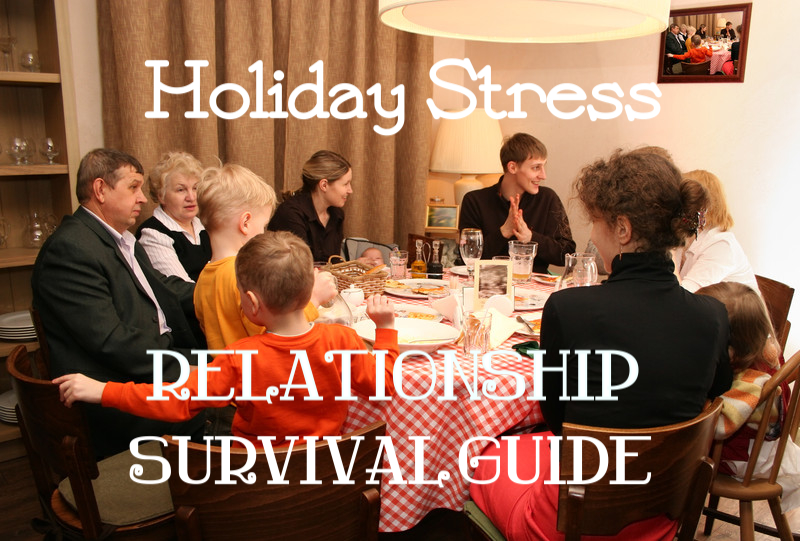
Let’s face it; as much as we love the holidays, they can be stressful, especially on our relationships. In fact, holiday relationship stress is the most common thing I hear about in my psychology practice this time of year. Whether it’s kids, parents, partners, siblings, friends, or extended family, the stress of the holidays can definitely push relationships to their limits.
Holiday Relationship Stress & Expectations
So, what causes holiday relationship stress? There are a plethora of answers we could list here, from past relationship issues, to financial stress, to the “busyness” of the holiday season. But, for the most part, holiday relationship stress really boils down to one thing: expectations. Specifically, two types of expectations:
1) Expectations from others: Your in-laws expect you to visit for the holidays, but you really want to stay home. Your kids and spouse want to stick with the old traditions, but you want to start some new ones. Your parents and siblings booked a small cabin “for the whole family” to stay together for 3 days/nights, but you’re already exhausted and know it’s a disaster waiting to happen!
2) Expectations from yourself: You expect the perfect gift from your husband. You expect the kids to gather lovingly at your feet each night for hot cocoa and a holiday story. You expect your friends to add to the magic of the holiday season, not add more drama to your life with their personal problems. You expect your extended family to understand why you’re staying home for the holidays this year.
I’ve said it before, and I will say it again, “All frustration comes from expectations”. And at no time are expectations higher or loftier than during the holiday season.
Holiday Relationship Survival Skills
So, what can we do to ensure our relationships survive the holidays? Start by following these three simple rules:
1) Examine, alter, and communicate expectations. When your expectations are too high or unrealistic, you’re setting yourself up for failure. Instead, identify what you expect and compare it with the expectations of your loved ones. If they don’t match up, then you either need to alter your expectations or your reality. (Hint: It’s much easier to alter expectations than reality!)
If your expectations, however, are realistic, then make sure you communicate them. For example, if you expect a nice gift and he expects no gifts, you should probably discuss and compromise before the holidays hit, otherwise you’ll end up frustrated and disappointed. (For more on this, check out “Frustration & Expectations: 4 Steps for Lowering Expectations & Obliterating Frustration”).
2) Listen to your heart, not your head. It may seem counterintuitive to let your heart run things during the holidays, but I’ve found that, when we’re talking about relationship stress, we tend to ignore how we really feel because our head tells us to “be nice” to others, to make sure they’re not hurt, to just keep the peace. And while all of these are worthy ideals, they’re not always the healthiest for us or for our families. That’s where listening to your heart comes in. Ask yourself, “What is the loving thing to do?” Then do it. And remember– “pleasing” others and “loving” others is not the same thing; and you don’t have to please others in order to love them.
3) It’s ok to set boundaries: Healthy boundaries=Healthy relationships. Most of us think if we set a boundary we are just “hurting” or “keeping love away from” others. Sure, others might not like our boundaries (especially if we’ve never set them before), but boundaries are really there to help us express our needs and keep us safe and healthy, so we can send more love out. Yes, setting healthy boundaries is quite often the loving thing to do.
Imagine if you never set boundaries with your children, allowing them to talk disrespectfully and order you around. Is that healthy? No. Setting a boundary of “you will treat me with respect” makes you, your child, and your relationship stronger. The same goes for your partner, friends, and the rest of your family. When you know you’re just going to be upset, hurt, or otherwise negatively impacted by a person or a situation, boundaries are necessary—for you and for them. Identify what you need, communicate it and then keep your boundaries.
“How do I implement my new ‘Holiday Relationship Survival Skills’?”
Good question. To get you started using your relationship survival skills, I’ve listed a few ideas. Try one, several, or discover your own ideas, and make this holiday season a time for your relationships to not only survive, but to thrive!
With Kids:
Ask each child “What is your favorite tradition?” and then focus on only those things. Asking allows them to communicate their epectations to you. And that allows you to choose to focus on what matters most to them and let go of any other expectations you thought they had of you. Chances are your children don’t care as much as you do about most of what you’re stressing about.
Couples:
Think of one or two things you would like your spouse to do for/with you and then clearly communicate those things. State, don’t ask for your expectations to be met. Say, “This is what I need. How can we make it work?” (Watch my 30SecondMom tip on this!).
Be ready and willing to compromise. If you want your needs met, you have to be willing to also meet your partner’s needs. Listen to their expectations, then help them identify whether those expectations are realistic or not and how you can meet them half way!
Remember their love language. If they care a lot about gifts, make sure you get a good one. If they’re more about verbal affirmations, write a poem or make sure to continually tell them you love them. Speaking the language of love they like to hear will help you both feel close and connected all holiday season! (Watch my 30SecondMom tip for more on this!).
Extended Families:
Remember, you really can’t please everyone, so focus on communicating your love to your family while ensuring your own well being too. Simply say, “I love you, and this is what I need right now.” For example, you could agree to a holiday dinner with extended family, but not the entire 3-day cabin stay. You could stop by your in-laws for an hour or two, express your love and gratitude and then go home. Or, you could opt to do things on your own this year or alternate years to try something new. It’s even ok to simply say, “You know I love you, but it’s just not going to work for us this year.” Remember to use your heart and do the loving thing!
Friends:
Involving friends in your holiday plans can be a wonderful time to reconnect. But if they’re not in a healthy place, it can be tough. For friends who are in crisis during the holidays, just remember to ask yourself: “Is this my problem or theirs?” You are not responsible for other people’s problems. If you can support them, then great! But if they’re dragging you down it’s ok to say, “No.” Remember, healthy boundaries are good for healthy holiday relationships.
What do you think? Do you ever feel like holiday relationships are challenging? How so? How do YOU handle holiday relationship stress? Leave us a comment below!
Read More
17 Secrets for Making Marriage Work (In Honor of our 17th Wedding Anniversary)
17 Secrets for Making Marriage Work
(In Honor of our 17th Wedding Anniversary)
I am honored today to host my very first guest collaborator—my husband, OJ. OJ and I met in college and just celebrated our 17th wedding anniversary on October 19th. We’ve been through some huge challenges over the years (here’s an example) and we’ve seen some great successes (here’s an example). But the biggest success, in my mind, is not that we’re still married or that we still love each other; it’s that we genuinely like each other very much—and our “like” keeps on growing.
But that in no way means we find marriage “easy”. Ha! No! Not at all. We have our disagreements, struggles, insecurities, and yes, even, our all-out fights. As I tell OJ all the time, “You are the one person in the whole world who drives me the most crazy! In both the good and the non-good way!” And he always laughs and says, “Of course I am! We’re married!” Yes, no matter how “good” a marriage is, it requires work, hard work, and, very often, simply “making it work” (as Tim Gunn would say).
17 Secrets for Making Marriage Work
So, in honor of our 17 years, OJ and I would like to share our “17 secrets for making marriage work.” Some we learned years ago, and others we’re still working out, but we hope that one, two, or all of our secrets will help your marriage work too! (Though we agree on all of these, OJ’s tips are preceded by his name and written in his own words!)
1) (OJ) Make sure your core values are in harmony, even if they’re not at the same “burning” levels. When it comes to whether to have kids or not, religion, politics, financial principles, and basic life values, it’s very tough to make a great marriage with glaring differences. Make sure you look closely at this before you tie the knot—it can make or break you!
2) Accept responsibility for your mistakes. A while back I realized (and explained to OJ) that too many of our arguments grew out of each of us being too defensive. Since then, I try to make myself admit my mistakes and apologize as soon as I see them. And OJ is constantly saying, “My bad…” when he says or does something wrong. It’s hard to be upset when your spouse admits their mistakes.
3) (OJ) Be on each other’s side when it comes to the kids. Don’t let the kids pit you against each other. Back each other up. If you disagree with your spouse, back her up in front of the kids and then discuss it in private. The kids need to know you’re a united team, and your wife needs to know it too.
4) Learn & speak each other’s “love languages”. If he loves physical touch and you love verbal affirmations, it can feel like you’re literally speaking a foreign language to each other. Learn to speak the “love language” that your spouse speaks. For instance, if I offer up a little “physical touch,” OJ’s so much more likely to help with the kids, give me “free time,” and talk about my day. (Watch my 30SecondMom tip on Love Languages).
5) (OJ) Space is a good thing in a marriage. Having your own hobbies, friends, vacations, and sometimes even sleeping quarters can help each of you feel like your individual needs are met, and this helps you come back even healthier and happier to your relationship. As long as it doesn’t become an “all the time” kind of thing, having time apart works wonders!
6) Build the “like” as well as the “love”. It’s great to build the romance, but it’s perhaps even more important to become great friends. Get to know each other. Talk and share your lives with one another. Have fun together. Play together. It’s just as important to build the “like” as it is to build the “love”.
7) (OJ) Say “No” to the kids and “Yes” to time alone. It’s so easy to get overscheduled when you have kids. And that not only takes time away from your relationship, it can place a strain on it. You just have to say “no” to too many activities, traveling sports that keep you apart all the time, etc., and say “yes” to time together without the kids.
8) Never discuss important matters when it’s late and you’re tired. In fact, we have a rule: “No serious discussions after 10 pm.” Having heated discussions when you’re tired is a recipe for disaster! Just say no.
9) (OJ) Be polite. Talk nicely and respectfully to each other. It goes a long way.
10) It’s OK to go to bed angry sometimes. In fact, it’s often the only way to stop the crazy arguments that come from exhaustion (when rules 8 & 9 are not followed). I always feel like I can see things more clearly with time and sleep. It gives both of us distance and helps us calm down, so we’re much more likely to resolve things the next day.
11) (OJ) Take vacations without the kids. You need time completely alone to remember why you fell in love in the first place, to
experience new things together, and to just be you, as a couple.
12) Jump off “cliffs” together! OJ likes to jump off literal cliffs (like this huge one in Costa Rica), and I like to jump off symbolic “cliffs” (like writing my first book). And sometimes life pushes us both off “cliffs” we aren’t sure we’ll even survive. Marriage is an adventure, so encourage each other to come along for the thrill; then make sure you’re always waiting, smiling, & cheering for each other at the bottom!
13) (OJ) Indulge in each others’ dreams and fantasies. I went with Christi to Europe not because I wanted to go to Europe, but because she did, and we had a fabulous time (see us at the top of the Eiffel Tower, photo top left). Likewise, she indulges in my dreams too, like “hook-ups” in odd locations (the Huey Lewis concert; the mountaintop…). (Me: Ok, dear, we get it).
14) Practice thinking fondly of each other when you’re not together. Building the positives up in your mind is so helpful. Think of what you love about him/her; remember to send a kind little text; or just sit and think of one thing you appreciate, and smile.
15) Support each other’s hobbies and interests. OJ loves to golf—I mean he LOVES it. In fact, he’s trying to golf so often I call golf his “mistress”. But I see how happy it makes him, and I want him to be happy. And he wants me to be happy too. We used to do “time for time”—where however long he was gone, I’d get the same time to do what I wanted. But now, when we each have something we want to do, we simply try to make it work. Because a happy spouse is a good thing.
16) (OJ) Grow together. So many couples who’ve been married a long time and get divorced say, “We just grew apart.” To that, we say, “Grow together.” Keep tabs on your friendship, your goals, and your values. Keep the conversation open. Make sure you grow together.
17) Laugh often. Research shows that couples who laugh together have stronger relationships. And couples who can laugh and tease even in the midst of tense discussions are even stronger. Laugh at yourselves. Laugh at the silly things the kids do. Laugh at each other (kindly), especially in those moments when you can see how ridiculous you’re both acting. Keep the fun, lightness, “like,” and love in your relationship by laughing together as often as you can.
Whether you’ve been married 1 year or 40 years, I’d love to hear your secrets for making marriage work. Leave us a comment and share below. We couples need all the “secrets” we can learn!
Read More
Dr. Hibbert Joins “30 Second Mom”!
Hello everyone! I am so happy to announce that I am now a regular contributor for 30SecondMom!
30 Second Mom is a fabulous website and smartphone mobile app that gives tips to moms in 30 seconds or less. All you have to do is visit the site, set up your login, select the topics and contributors you’d like to follow, and voila! Tips appear on your “stream,” tailored just for you! So, if you’re a mom-on-the-go, take a moment and visit www.30SecondMom.com. This just might be the “tip” you need to make your full life just a little smoother!
Check out a couple of my tips:
Starting Over: What to Say When a Conversation Turns South
Summer Survival: Helping Your Kids Set Summer Goals (watch the 30 second YouTube video of this tip)
Read More
Parenting Practice: 7 Strategies for Summer Sanity
Parenting Practice:
7 Strategies for Summer Sanity
Summer is upon us once again with its longer days and warmer weather. Yet for we parents of school-aged children, summer break can be anything but relaxing. I admit, my past few summer breaks have started with a mental breakdown on my part. But this year is different. I have looked back, taken notes, and learned from my mistakes; with only four days of school left, my summer sanity plan is firmly in place. So, allow me to share my 7 strategies for summer sanity in hopes it will bring a little sanity your way this summer too!
1) Evaluate & adjust expectations. This is a biggie. As I’ve written before, “All frustration comes from expectations” (Dr. John Lund); expecting your schedule to remain the same in the summer is simply not possible and your sanity will pay the price if you don’t make some changes. For example, I’ve learned that I need to cut back on my own “projects” during the summer. The less I expect to get done, the less interrupted and frustrated I feel. Instead, I now try to read, relax, and play a little more in the summer, reminding myself that, even though I’m not getting much of my “to do list” done, I am doing some very important things (like strengthening my relationships and resting up for the fall). Expecting a little less in the summer can bring a whole lot more peace of mind. (For tips on altering expectations, read this).
2) Set up summer rules. What are your policies for summer sleepovers, playdates, chauffeur services, and chores? Call a family meeting, discuss, and write them down; then, post them in plain sight. Having written “rules” takes the guess work out of summer days, providing structure and helping children (and parents) know what to expect. One of our rules involves “Summer Kitchen Hours”. These hours are posted next to the other rules, telling the kids when the kitchen is “open” and when it is not. This helps prevent constant grazing and entices my hungry teens out of bed a little earlier, but mostly it helps me feel like I’m not constantly cooking and cleaning. What policies might help your summer run a little more smoothly?
3) Don’t over- or under- schedule. While it certainly helps to have some scheduled activities each week, resist the temptation to sign up for too many. Let’s face it—we live in an overscheduled world, and overscheduling wears parents and kids out. Instead, let summer be a time to slow down from the hustle and bustle of the school year. Planning one activity a day is plenty; and it’s ok to have days with nothing planned at all. It’s actually good for kids to have “nothing to do” sometimes—it allows them to hear their own thoughts and invokes creativity; it also helps them appreciate all they get to do at other times. When my kids start in with “I’m bored,” I tell them, “Great! I’m happy you’re bored—it’s good for you! Go sit and be bored for a while!” This gets plenty of eye-rolling, of course, but usually does the trick. (If they continue complaining, I say, “Oh, good! I need someone to help me get this work done”–they sure run away quickly after that one!). So, be careful with your scheduling–keeping kids (and you) entertained but not drained is a fine line to walk!
4) Do activities that you enjoy. Hiking? Reading? Drawing? Gardening?—whatever you love, look for opportunities to share it
with your children; it’s a great way to teach them about the things you love. I love travelling, and now that I no longer have babies in tow taking my kids on trips is something I adore. (The photo to the right, is from when I decided [the week before] to take the fam to Utah. Once there, I took all the kids to Sundance for the day, to hike, bike, ride the lifts, and play frisbee [while my husband played golf]!) I also love music, so writing songs and playing instruments together is another great activity for us. The point is to find what you love and do it—you’ll be so much more engaged in what you’re doing, and your kids will be so much the better for it!
5) Set up some summer help. To avoid breaking down you need some breaks, and summer camps, babysitters, family, or friends can be a big help. You might set up a childcare co-op and swap “free time” with a friend; you might enlist grandparents to take the kids for a while; or, you might ask your partner or spouse to take over for a night or day each week. Whatever your situation, look for opportunities to get some help and then take them! Your sanity will thank you for it, I guarantee.
6) Create daily quiet time. Whether you’re a stay-at-home parent, a work-at-home parent, a work-at work parent (oh, let’s face it—we’re all working parents!), you need some time and space that is just for you. Being “on” all the time is a sure way to burn out. To prevent burn out, set up daily “quiet time”. In our home we have 1 hour of “quiet time” each afternoon. I help the little ones settle down with books, a movie, or coloring, put a sign on my door (“Mom’s Quiet Time—Please Do Not Enter”) and hit my bed for reading, a nap, and usually some dark chocolate. The older kids entertain themselves and they all know not to interrupt or else “mean mom” might make an appearance. It’s good for everyone to have a break from activities and from each other. What can you do to establish some quiet time each day?
7) Be flexible. All this being said, summer really is a test of flexibility. Just because you have a summer “plan” doesn’t mean it won’t change–it will. Just count on it. Remembering strategy #1, if you can expect things to change, you will handle those changes much more smoothly. Just roll with it—that’s what summer is all about. (For more on flexibility, read here).
So, here’s to the summer of sanity! My hope is that, by using these 7 strategies, your summer will not only be more a little more sane, but perhaps even a little (or a lot) more satisfying too!
What are your summer survival tips? What gets you frustrated? What have you found to make things easier? Help us all out by leaving a comment below!
Don’t miss a thing! SUBSCRIBE, below, and please “Like” my Facebook page, for inspiration & updates on the topics that interest you most!
Related Posts/Articles:
“Mommy Fails” & Mother’s Day: 3 Messages Every Mom Needs to Hear
Parenting Practice: Getting Good at the ‘Let-Go’s’
Parenting Practice: “Sit Back & Enjoy the Ride”–Making the Most of Family Drive Time
Parenting Skills: “My Kids Are Driving Me Crazy!”–10 Ways to Drive Us Back to Sane
17 Secrets for Making Marriage Work
50 Ways to Love Your Loved Ones
How to Get Your Needs Met: 4 Tips on Asking & Receiving
The 5 Love Languages: Improve Relationships & Feel the Love
“Let’s Get Real”: 10 Confessions from “The Psychologist, The Mom, & Me”
5 Reasons Self-Esteem is a Myth
Frustrations & Expectations: 4 Ways to Lower Expectations & Obliterate Frustration
30 Second Mom Tips/Videos:
Mommy Mental Health Tip 1: Prioritize Your Mental Health
“Going from 3 to 6 Kids”: The Moment I Really Felt Like a Mother
Use Drive Time Wisely & Connect w/ Kids in the Car
What I Love Best About Being a Mom: My Kids Know They’re Loved
Read More
The Baby Blues and You
Your Postpartum Emotions:
The Baby Blues & You
Up to 80% of all new mothers will experience what is called “The Baby Blues.” If you are aware of this fact then lucky you because many families have no idea what is in store emotionally after the baby is finally here.
Postpartum Emotions for Moms & Dads
Too many families are never told that 4 out of 5 moms will feel sad, frustrated, tearful, anxious, and/or overwhelmed, what many women describe as “an emotional roller-coaster,” in the first days or weeks postpartum. If you think about it, it makes perfect sense that your emotions might be a little out of whack after pregnancy and childbirth, considering all your body and mind have been through. The abrupt changes in hormones, sleep deprivation, and the psychological adjustment to becoming a parent, not to mention the exhaustion of labor and delivery, can easily trigger fluctuations in emotions.[/two_third]
And those first few days are not just tough on moms either. A dad can also have the Baby Blues and is more likely to have symptoms if his partner has symptoms too. It’s sadly ironic that just when we parents desire to be at our very best, we are often physically and emotionally at a disadvantage.
The Good News
The good news is that The Baby Blues are temporary. Neither a “diagnosis” nor a “disorder,” The Baby Blues is a normal reaction to the stress surrounding childbirth, and symptoms should improve within two weeks or so. Knowing this helps normalize the craziness we feel those first few days and relieves the layers of stress we add when we start to fear we are not “normal.” Feeling emotionally abnormal at this time is, in its own way, normal. And telling ourselves we’re “normal” can be just the relief we need even if we are the only ones saying so.
What Can We Do?
So here are a few things couples can do to safely navigate the baby blues:
1) Education: Learning all you can about postpartum emotional adjustment can help normalize your symptoms and also tell you if or when it may be time to get some outside help.
2) Practical Support: Letting others help with housework, childcare, and other basic duties can give you the space you need to let yourself (and your emotions) settle in and heal. It can also give you a chance to catch up on that much-needed sleep that’s likely wreaking havoc on your emotional state!
3) Emotional Support: Having a trusted friend, partner, or family member you can talk to can make all the difference. It’s ok to feel what you’re feeling and having someone who is ok to let you feel it may be just what you need.
4) Partner Support: My best advice for couples is to be patient and kind with one another. Realize this time for what it is–a temporary adjustment period when a tiny baby has all the power and the helpless adults are simply trying to keep up!
Beyond The Baby Blues
The Baby Blues can feel very permanent but they really should only last for a few days or maybe a couple of weeks. If your “blues” are hanging on longer than two weeks or if your symptoms seem to be getting worse you may be experiencing a postpartum mood or anxiety disorder. Seeking counsel from an expert in perinatal mental health can help determine what your emotions are really up to and give you the tools you need to overcome them. (For resource options, click here).
Hang In There!
Your emotions may feel out-of-whack but that’s just part of having a baby. Eventually your body and emotions will resume a more “normal” routine. In the meantime, hang in there. It really does get easier over time, and it really is ok to just give in a little bit and go along for the ride.
Questions about the “Baby Blues”? Leave a comment and let me know!
SUBSCRIBE to our newsletter and updates by completing the form to the right.
Read MoreKick The Complaining Habit!
Kick the Complaining Habit!
No body likes a whiner. Even my four year-old, Sydney, came home the other day from her babysitter and, after asking her how her day was, she said, “Pretty good, mom, ‘cept one thing was bad—Tyler* was whining all day!” (Tyler is her three-year old “boyfriend” she is always trying to kiss, to be like her older siblings, and yes, *his name has been changed to protect his innocence). As I said, no one likes a whiner.
Why Complain?
I have to admit, I’ve been known to complain or even “whine” on occasion too. It seems that the more stressed and tired I am, the more verbal I become until I lose my filter and every little thought becomes public notice! I don’t even like being around myself when I act like this. So why is complaining such a draw for so many of us?
There are definitely those who complain simply out of personality style or habit. Circumstances like stress and fatigue can certainly influence our tendency to complain too. But I believe complaining usually starts with purer motives: Most of us simply want to be heard and understood. We want someone to know our frustrations, pain, or upset. We want to know we are not alone. No matter what lies beneath it, however, complaining is a habit worth kicking before it fills us with so much negative energy that we drive those we love away! And even more importantly, complaining is a habit we can kick.
No Complaints!
So, what can we do? Some may think the advice, “Keep your thoughts to yourself,” is the way to go. But even though painting on a fake smile, keeping quiet, and always being “fine” may seem like a good idea, it’s bound to eventually lead to either an explosion, an implosion, or at least some really good meat for therapy later in life.
The trick is to be able to talk about how we feel without delving into the pool of indulgent complaints. Here are a few tips to help us strike this healthy balance:
1) Write down complaints. We complain because we have a pile of emotion inside that needs to come out, and writing is a great alternative to saying it out loud. There is something therapeutic about getting things out with a pen and paper (or computer keyboard). It can also help to see our complaints; it can validate those times when things really are crazy and help us let go of the times when they’re not as bad as we think, all without dumping on those we love.
2) Set a “complaining” appointment. It may sound a little bizarre, but setting an appointment for complaining can help too. A time limit will keep it focused. For instance, “I can’t complain at all until 3:30 pm, at which time I will tell all my complaints to my husband with a time limit of 10 minutes”. (It helps to tell the person we’re complaining to ahead of time that we are simply “venting” and don’t need anything more than a listening ear). Not only does this give us a guaranteed chance to air our complaints, it channels our complaints and stops us from needlessly dragging them on. And, most of the time, we’ll probably find that our “complaining appointment” is not even worth keeping.
3) Solve what can be solved, then let it go. The previous tips can help us sort out complaints and give us the voice we desire. But ultimately our complaints need to either be solved or let go. If there is something we can do to handle our complaints, then we do it. If not, then we vent it out and let it go. We will be so much happier and so will those around us.
Kick the Complaints!
So, try these tips and start kicking your complaining habit today! Or try the advice I recently heard from a speaker whose mother taught her that if she added a “Dear Heavenly Father” to the beginning of each complaint and an “Amen” to the end, it’s no longer a complaint, but rather, communication with God. What a concept! He is, after all, probably the only one who really wants to hear our complaints, and the only one (besides us) who can do anything about them.
What do you think about complainers? Are you one? What makes it such a hard habit to kick? Have you found any strategies that work for you? Leave us a comment and share your wisdom!
SUBSCRIBE to our FREE newsletter and updates (including blog post updates) by registering (see the form to the right)!
Read MoreThought Management: Part 1
Thought Management: Part I
The Link Between Thoughts, Feelings, Body, and Behavior
One of the best tools I’ve learned as a psychologist, mom, and human being is how to understand and change my thoughts. It’s estimated that humans have an average of 60,000 thoughts per day! Were you aware you were thinking so much? Probably not, for a vast majority of these thoughts are what are called “Automatic Thoughts”—they come automatically, without any conscious effort on our part, and most of the time we don’t even hear them. The problem is that our thoughts are linked to our bodily reactions, emotions, and behaviors. Even thoughts we don’t intend or want can set off a cycle of sensations, emotions and behavioral reactions, leaving us feeling out of control. But learning to see the connection between thoughts, feelings, bodily responses, and behaviors empowers us.
The Thought Cycle
Allow me to explain how this works. Life gives us situations. For example, I am walking through the forest when I see a bear. An automatic thought arises, “Ah! There’s a bear!” This thought creates a physiological response: my blood pressure rises, pulse increases, heart rate speeds up, and adrenaline pumps through my body. Almost simultaneously there is an emotion, or several emotions. Facing the bear I feel anxiety, panic, and fear; I then engage in a behavior. In this case, I run away from the bear. (Now, I have learned recently that the best thing to do when encountering a bear is actually not to run away, but for the sake of this example, we will ignore that little fact). Let’s say I run away to safety. What is my next thought? Perhaps, “Wow! I am safe! Way to go, me! Whew!” And my body’s response is for my parasympathetic nervous system to kick in, my heart rate slows, pulse lowers, and breathing resumes a more natural pattern. I have some emotions—joy, relief, satisfaction! And my next behavior? I go out for an ice-cream cone to celebrate my success!
But let’s say I’ve been raised to believe I am good-for-nothing—I am a wimp, I overreact, I always run away from my problems. In this case, after I find myself safely out of the bear’s reach, my thoughts might sound like, “You are such a wimp! Why did you run? It was just a small bear. You probably could have taken it! Why are you always such a coward?” My body’s response would be to keep the cortisol and adrenaline flowing, my stomach would become upset from tension, and my breathing would remain fast and shallow. My emotions might include frustration, anger, disappointment, and self-loathing. And my behavior? I would go and eat an entire carton of ice-cream as form of self-punishment.
This is Aaron Beck’s cognitive-behavioral theory in a nutshell. We can see that not only are thoughts, feelings, the body, and behaviors connected; they are influenced by the thoughts, feelings, reactions and behaviors of our past. And once we can see this cycle, we have a choice: to either ignore what we see, or to listen and intervene when we hear something that doesn’t quite make sense.
Case Example
My own classic example comes from when I was in graduate school. Here I was, two kids, my husband in dental school, attending a full-time doctoral program, working part-time as a fitness instructor, and obviously surviving on very little sleep. One day I came home to a surprisingly empty house. My husband, OJ, had picked up the boys on his way home and taken them to the park, and I had 2 blessed hours alone. I immediately started cleaning, trying to remedy the bomb of Superman capes, lion’s tails made of belts, Scooby-Doo bowls and silly straws, that covered what once had been our living room and kitchen. It wasn’t until I dug into the pile of dirty clothes to start several loads of laundry that I noticed my body was tense, my frustration mounting higher than the pile before me, and I heard a sing-song voice within say, “I can’t handle this! I’m going to freak out!”
“Wait a minute,” I said to myself, “I heard that! What exactly can’t I handle?” It was the first time I had heard my automatic thoughts and stopped to question them. I was just doing laundry, so why was I so frustrated? After a few moments of listening I heard my answer, “I’m exhausted. I have a quiet home. I want to take a nap, and instead I have to clean and do laundry.” Well, did I have to do the laundry right then? No. It was a choice I had made. So, I decided to unmake that choice and instead choose to take a nap. Sure, the house was still a mess when my family came home, but the difference was that I was no longer a mess.
Can you see the power that listening to and altering your thoughts can have on your life? Through practice we can train ourselves to pay attention to the important thoughts and gleam valuable nuggets of truth—about how we feel, what we need, and ultimately, who we are. Then, we can let the rest go.
Of course, it’s hard to do at first; like any new skill it takes practice to hear, challenge, and change unhealthy thoughts. So it’s best to start small. I suggest if this is new to you that you start by simply trying to hear what you tell yourself in stressful, overwhelming, or even supremely joyful times. Begin to notice the impact your thoughts are having on your life.
Set Yourself Free
It takes time to master your thinking, but believe me, it is well worth the effort. I still use these valuable skills every single day, and I’m teaching them to my children now too. I hope you will join me for part II of my “Thoughts” series, where we will learn to use a Thought Record, and begin to challenge the thoughts that you will, by then, be so much better at hearing. Stick with us as we learn the powerful skill of managing our thinking and discovering the truth of how we feel, behave, and the truth of who we are. After all, you know what they say: “The truth shall set you free.” It will. I assure you. It will.
~This post is based on an excerpt from Dr. Hibbert’s forthcoming book, This is How We Grow
Questions? Comments? I’d love your “thoughts” (pun intended!), so leave a comment below!
Thought Management, Part 2: Coming Soon!
Related Posts:
5 Reasons Self-Esteem is a Myth
If Self-Esteem is a Myth, then What is the Truth?: Understanding Self-Worth
Self-Esteem vs. Self-Worth: Q&A with Dr. Christina Hibbert
“Sleep Better, Cope Better”: 6 Insomnia Causes & Cures
How to NOT Be Ungrateful: 10 Things for Which I am NOT Ungrateful
Read More
Women & Friendship: The ABC’s of Making & Keeping Friends
Women & Friendship:
The ABC’s of Making & Keeping Friends
“Make New Friends, But Keep the Old…”:
Today and tomorrow I’m attending one of the largest women’s conferences in the world at my alma mater, BYU. Sitting beside my BFF, Leonore, and surrounded by thousands of remarkable women and their BFF’s reminds me of the power of women & friendship.
Leonore and I have been friends for almost 10 years. We met at church two days after I moved to town. I was holding my newborn daughter and stood up to introduce myself: “Hi. I’m Christi. My husband, OJ, and I have three kids. We just moved back to Phoenix from Los Angeles, where we’ve been living for four years for graduate school. Two weeks ago today I graduated with my doctorate in psychology. One week later I gave birth to my third child. Five days later we moved here. I guess that’s it!” Needless to say I had been feeling quite overwhelmed by all of this, so I was happily surprised and very grateful when Leonore came up immediately after, introduced herself, and invited me to a party later that week!
What prompted Leonore to be so friendly to me? First of all, she’s a very friendly person. But moreso, she was looking for a good friendship too and took advantage of the opportunity. The way she tells it is: “I heard Christi stand up and say, ‘Yeah, I just graduated with my doctorate and had a baby and moved,’ and I thought, ‘Wow, I’ve got to be friends with her!’ So I just ran over, introduced myself, and invited her to a party.” Leonore is definitely an “A” friend. I’ll explain what I mean by “A” friend a little bit later, but first, I’d like to talk about friendship a little bit.
Friendship Facts & Tips
I can’t tell you how often the topic of friendship comes up when I’m working with women in therapy–women who feel like they have no real friends, women who worry their old friendships just aren’t working anymore, women who stress over finding “good” new friends, and women who feel guilty that they can’t live up to what their “good friends” need. When we were children it seemed so simple! I watch my 4 and 8 year-old daughters make friends in minutes wherever they go all the time! But for us “grown-ups” friendship can be much more challenging.
So what are the facts on friendship? How can we create a circle of friends that is healthy for us? Is it really even that important? Here are a few facts and tips that might clear things up.
1) Friendship is important, especially for women. Girlfriends fill a void that partners or spouses usually can’t fill. Sharing tips, emotions, and advice; laughing, crying, and venting, there’s just something about women being with other women that can let us know we’re not alone, help us recharge, and motivate us to go home even better than before.
2) Each person’s friendship needs are not the same. Most of us do not understand this principle. We think that we should all somehow feel the same about friendships and have the same needs, forgetting that each person’s friendship needs are just as unique as we are! Some of us need companionship for frequent outings and events, while others need only one or two close companions to talk things over with on the phone. Some friends need continual contact, while others you might not see for months and then pick up right where you left off (like Leonore and I!). We must learn to be more understanding of the other person’s needs and to accept that even though our needs are different, neither way is “the right way”. We can work to compromise and meet in the middle, or sometimes we may need to accept that our needs are too different and the friendship just isn’t working, and that’s ok too.
3) Friendships change over time. Life events can change a friendship. For instance, when one friend has a baby and the other does not, it can distance the two worlds so much that the friendship simply drifts away. Friendships often fall apart in times of crisis or great stress too, when one friend is suddenly in great need and the other is not able or willing to fill those needs. Whatever the circumstances, friendships do change as our lives change. Remember that this is simply part of growing. As I learned on Pinterest, “As you grow up you don’t lose friends, you just learn who the real ones are” (http://pinterest.com/pin/134756213820487705/)!
4) It’s ok to let go of friendships that no longer work. You will know whether it’s worth the effort or not to keep the friendship. If it’s not, then just wish your friend well and hope you might meet up again in the future. It may be a relief to them too or it may disappoint them. Either way, it’s ok if it is done kindly. (Disappointing others is ok too; it’s part of life). Then, move on. As the children’s song goes, “Make new friends, but keep the old. One is silver and the other’s gold.” Keep the old friendships that are still working, but don’t be afraid to seek out new friendships that might better suit your needs at that time.
The A,B,C’s
Often we’re uncertain what a “healthy” friendship even means. We may think that everyone needs to be our BFF or we may feel like we need hundreds of acquaintances to be “healthy”. Let me just clarify: Healthy is relative. It’s different for everyone. So how can you know what is healthy for you? Allow me to explain the ABC’s of friendship. This helps me create strong, healthy friendships and it will hopefully help you too.
There are A friends, there are B friends and there are C friends.
Your B friends make up the bulk of your friendships. You like each other, you have fun together, you hang out. They’re good people that make you feel good too—that’s why they’re your friends! B friends are good to have, and you can easily maintain dozens of B friendships at a time.
Then there are your A friends. This is the smaller group of people who you not only like, hang out with, and have fun with, but these are the friends you really “click” with. These friends know you in and out; they really “get” you. But even more, these friends truly inspire you, they push you to be better, and they make you a better person. You will naturally have fewer A friends than B friends. It’s just the way it is. And research shows one, two, or three A friends is all you really need. I repeat: one, two or three A friends is all you really need. Remember that next time you feel like you “only have a couple close friends”. That’s the way we women, for the most part, were made to be.
What about the C friends? These are the friends who, for whatever reason, bring you down, who try to get you off track, or suck you into their own drama so often it helps no one. While you’re kind and friendly to C people, you need to be careful not to spend too much time around them. Exercise caution if you find yourself surrounded with C people. It’s ok and even healthy to set boundaries with friends who are not a good influence. After all, how can you become something you are trying to be when you are undermined at every turn (the same goes for family members like this)!
Quantity vs. Quality
In her book, MWF Seeking BFF, journalist Rachel Bertsche quotes journalist Valerie Frankel’s writings on friendship: ”‘Psychologists have long described four major types of friendships…1) The acquaintance, someone you’d chat with on the street or at a local cafe, who gives you a sense of belonging; 2) the casual friend, a ‘grab lunch’ pal who often serves a specific purpose, such as a tennis or running partner, 3) the close buddy, an intimate trustworthy comrade you can say anything to; and 4) the lifer, who’s as deep and forever as family.’ Franke’s resaerch found that women should have 3 to 5 lifers, 5 to 12 close freinds, 10 to 50 casuals, and 10 to 100 acquaintances”1. Again, the numbers of friendships each of us needs will vary greatly. I say that it’s not the quantity but the quality of friends in your life that really matters. You can have hundreds of acquaintances and still feel lonely. Or you may have one “lifer” and feel happy as a clam.
Bottom line:
Friendships come in all shapes and sizes, and they matter. Learn what you need from your friendships. Know that it’s ok to seek out friends that can fill those needs. Remember that you don’t need hundreds of friends and you probably won’t find even dozens of A friends. Take charge of who you let into your inner world by carefully selecting your friendships. After all, you become like your peer group, and if you never surround yourself with friends who lift you higher, how will you ever learn to fly?
I would love to hear your thoughts on friendship! What makes an “A” friend to you? Have you ever had to let a friendship go? How have your friendships changed over the years? Leave a comment and let us know!
1Bertsche, R. (2011). MWF Seeking BFF: My Yearlong Search for a New Best Friend. Ballantine Books; New York, NY.
Read More


!["The 5 Love Languages," [video] www.drchristinahibbert.com](http://www.drchristinahibbert.com/wp-content/uploads/2013/02/phonto-53-300x210.jpg)


Check out "Clinician on the Couch: 10 Questions with Psychologist Christina Hibbert" on Psych Central
Check out my 30SecondMom tips & make life easier in 30 seconds or less!


Facebook
GoodReads
LinkedIn
Youtube
Twitter
Email
Pinterest
GooglePlus
Learn more about IPE's Nutritionist Certification